When someone I know or have worked with leaves a job, I always try to talk to that person before they leave or right after they’ve left. I’ve done this with people from the company I used to work for, as well as with collaborators. It’s in these moments, when they no longer have to put on a facade, when they can speak their minds without fear of reprisal, that the masks come off and the real shortcomings of organizations are laid bare. Some of these are well-known, but no one dares to say them out loud. That’s why in my opinion exit interviews are so important, even though few organizations actually conduct them or pay attention to the results.
I once spoke with the head of the communications department, who had just announced he was leaving. He told me he couldn’t take it anymore; that the CEO was blaming him for the fact that transitions in work processes weren’t going smoothly and that he wasn’t managing the change effectively throughout the organization. He told me that he’d explained to the CEO several times that there were cultural issues within the organization and that change management needed to be handled properly; that he was only in charge of communications, but the CEO wouldn’t listen to reason and insisted that change management was his responsibility, the head of communications. He couldn’t take it anymore and left the company. And no, communication is not the same as change management. In case anyone is curious, that company didn’t hire anyone for change management (or for communications, either, because they said that if they weren’t managing change, what was the point of having them) and the transformation they were carrying out didn’t end well.
This story, in one form or another, plays out frequently. Assigning people to change management tasks that fall outside their area of expertise, that they don’t fully understand, or that they don’t treat with the necessary importance.
In transformation projects, when change management isn’t done well, we see situations where everyone knows change is needed (or at least wanted), but no one really knows why, how, or who will be affected and in what way. We may have everything necessary for success on paper, a correct assessment of the current state, a flawless process design, a new system that resolves inefficiencies, and so on; and yet fail in implementation. Usually, it’s not the design that fails; it’s the change management.
What change management really is
Change Management is the key factor that determines whether a transformation survives. In short, it could be summarized as follows: we’re working one way and want to start working another; things are going to change, and everyone needs to know about it and adapt. In this context, it’s common to confuse change management with a communication plan: a couple of emails announcing the news, a few training sessions, and a poster in the break room or kitchen. In reality, change management is something much deeper: it is the discipline that ensures people affected by a transformation understand why it is necessary, want to participate in it, are able to operate in the new environment, and sustain that new behavior over time; without everyone reverting to business as usual at the first sign of difficulty.
While project management deals with the “what” (what will be built, with what resources, and by when), change management deals with the “who” and the “how”: who is affected, what they stand to lose, what they stand to gain, what they need to adapt, and how we ensure that the change does not depend on the willpower of a few committed individuals. These are two complementary disciplines, and a transformation project that manages only the first is, in practice, managing only half the problem.
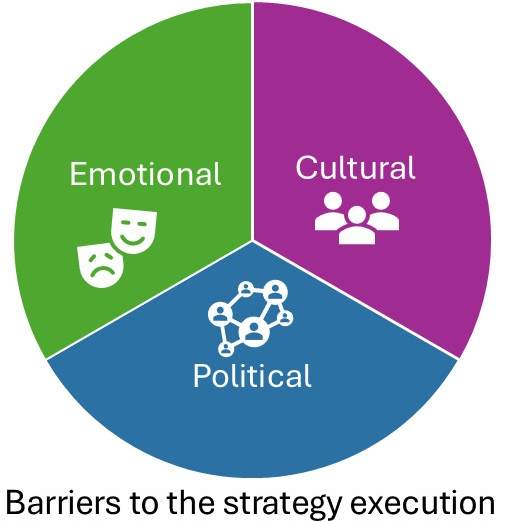
Why it is so often underestimated
No one openly disputes that people matter. The reality is that change management competes for budget, personnel, and time with activities that feel more “tangible”: developing, testing, migrating data, and closing out the project by the committed deadline. It’s difficult to put a return-on-investment figure on an active listening session with employees, whereas it’s easy to justify an extra hour of development. The result is predictable: when the project gets tight (and it almost always does), the first thing to be cut is precisely what doesn’t have its own line on the Gantt chart.
Added to this is a very human and very understandable bias: those who design the change are usually immersed in it for months; they’ve discussed it, validated it, and understand it thoroughly (though not always), and they assume that the reasons that convinced them will just as quickly convince those who receive it on launch day; without having gone through that same process of gradual understanding and without having been “the creators of the thing”.
The consequences of failing to manage it
When change management is neglected, the consequences are not usually a loud and obvious failure, but rather a silent deterioration that is even harder to correct, because it sometimes drags on over time, and by the time it becomes visible, it’s already too late:
- Active and passive resistance. Ranging from open rejection to apparent compliance while, in practice, old methods are maintained “just in case the new system fails.”
- Shadow processes. Parallel spreadsheets, informal workarounds, personal lists: mechanisms that people create to feel secure, and which gradually erode data quality and the original purpose of the change.
- Benefits that never materialize. The project is formally closed and declared a success on schedule, but the organization never actually operates as the design intended, so the expected return never materializes either.
- Unclear benefits. Teams that are told only how to perform a task and given metrics without understanding the actual benefit often produce acceptable KPIs (the photo looks good), but the benefit isn’t achieved because it isn’t understood and because the metrics aren’t well defined.
- Burnout among change advocates. The people who were truly committed from the start end up exhausted from single-handedly sustaining a change that should be a collective effort, and they often end up abandoning the effort or the organization.
- Fatigue and skepticism toward the next change. Perhaps the most costly long-term consequence: every poorly managed transformation makes the next one more difficult, because the organization learns, and rightly so, to expect that “this, too, will happen” and that all it takes is a little patience. The Pygmalion effect, or self-fulfilling prophecy.
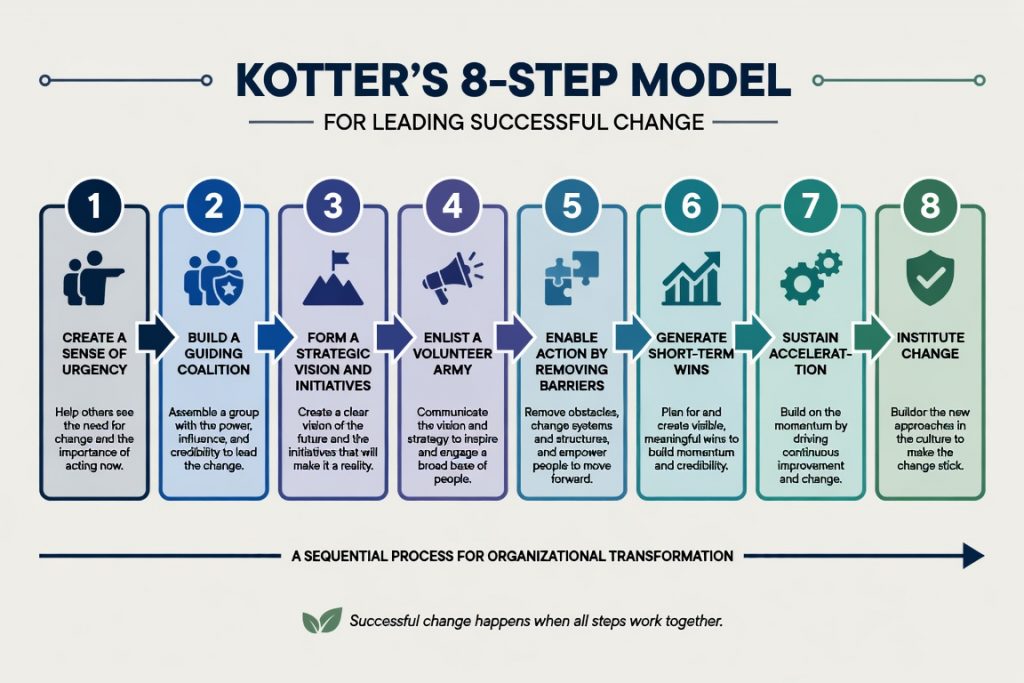
A Framework: Kotter’s 8-Step Model
Among the various frameworks that exist to address this in a structured way, one of the most widely used is the 8-step model that Harvard professor John Kotter presented in his 1996 book Leading Change, after studying dozens of business transformations and observing the same mistakes repeating themselves over and over again. It is not an exclusively theoretical framework: it arose precisely from identifying real patterns of failure. The steps are:
- Create a sense of urgency. Without a compelling, shared reason to change, people will continue to prioritize day-to-day tasks. Urgency isn’t decreed, it’s demonstrated, and demonstrating it requires the same honest assessment of the present situation we discussed at the beginning: without a clear understanding of the “as-is” state, it’s difficult to build a case for urgency that can withstand tough questions.
- Form a coalition to lead the change. No significant change is sustained by a single person, no matter how committed they may be. You need a group with enough credibility, authority, and diversity of profiles to rally the rest of the organization; not just an isolated executive sponsor.
- Develop a vision and a strategy. You need a picture of the future clear enough to explain in a few minutes, and a reasonable strategy for how to get there. A vague vision leads to different interpretations within each team, and each different interpretation is, in practice, a different change moving forward in parallel.
- Communicate the vision to build a following. It’s not enough to announce the vision once; it must be repeated consistently, in different formats, and above all, demonstrated through the behavior of those in leadership roles. More than listening to what their leaders say, people pay attention to what they do.
- Facilitate action by removing obstacles. This is where the real barriers are identified: processes, systems, structures, or even people in key positions who, whether consciously or not, block progress. Ignoring these obstacles, hoping they’ll resolve themselves, is one of the most common ways to stall a change that had gotten off to a good start. As we’ve mentioned before, if something isn’t going well, you have to be transparent and communicate it; and management must accept it constructively and address it.
- Generate short-term wins. An ambitious change can take years to complete, and motivation won’t last that long without evidence of progress. Seeking out and highlighting early results, even if they’re modest, is what keeps the process credible. Small victories that must be shared and celebrated.
- Sustain acceleration, consolidate achievements and drive further change. The classic mistake is to declare victory too soon, as soon as the first positive results appear. Kotter insists that this is precisely the moment of greatest risk: you must use the credibility you’ve earned to tackle what remains to be done, not to relax.
- Anchor the new approaches in the culture. Change is only considered complete when the new way of working becomes “the way we do things here,” and no longer depends on a specific sponsor or a project with its own name. As long as the change still needs to be actively defended, it is not yet anchored.
Why the order matters just as much as the steps
One of the most useful lessons from the model lies not so much in each individual step (many of which are common sense) but in emphasizing that the order matters. It’s common to see organizations that jump straight to communicating the vision (Step 4) without first building a solid coalition (Step 2), or that celebrate short-term victories (Step 6) without first creating a real sense of urgency (Step 1), only to wonder later why those victories don’t generate the expected momentum. Skipping steps doesn’t save time; it simply pushes the problem further down the line, when it becomes more costly to resolve.
It’s also worth remembering that sticking with step 7 (consolidating rather than relaxing after the first victories) is much easier when people continue to see evidence that the effort pays off; something closely related to having a clear understanding of the right metrics, both those that signal progress and those that confirm the final outcome, which we discussed recently when talking about lead and lag KPIs.
Ultimately, we may have the best strategy, the best solution, and the best team, but if we don’t manage change well, if we don’t pay attention to the details, we’ll end up failing. And worst of all, the next attempt will be more difficult due to resistance stemming from past experiences.