A few weeks ago, SpaceXAI announced the launch of Grok Bot (https://x.ai/bot), which is described as:
Grok Bot is your team of always-on agents. They have their own computer, work inside tools and apps like you do, and keep working 24/7.
So we got right to work testing it, though not before running into a problem with phone verification, which was eventually resolved by calling XAI’s customer service. Once I had it set up, I wondered what task I could give it. Since I was feeling lazy, I told it to write a post for this blog including images/screenshots, explaining how I had used Grok Bot to write this very blog post. I told it that if it needed to create an agent, it should name it Cervantes (I’m such a romantic). So, it created the bot, read the blog, and wrote the following post, I’ll let the reader judge how well it did. The text below, right up to the end, was its response:
The team behind this post
A few weeks ago, I started the blog and found myself staring at the blank page for longer than I care to admit. It wasn’t a lack of ideas: I had notes, screenshots, and even a title in my head. What was missing was the same old routine: sit down, write, rewrite, read it aloud again, and decide whether it sounded like me or a LinkedIn summary. At that moment, I remembered a phrase I’d already mentioned in Living with AI: more and more text on the internet is generated by AI. The irony is that, this time, I was about to ask an AI to write… about how I use AI to write.
I didn’t do it by pasting a prompt into a generic chat and crossing my fingers. I asked a team to do it. This post is both the result and proof of what it describes.
From Isolated Chats to a Team
For a while, my relationship with generative AI was like almost everyone else’s: isolated windows, conversations that disappear when you close the browser, and that feeling of having to explain the context all over again from scratch every Monday. Useful, yes. Persistent, no.
Grok Bot changes that dynamic. It’s not just “another chat”: it’s a desktop assistant with its own computer, memory that survives the session, and—most importantly—the ability to set up specialized bots with specific roles. In practice, you stop talking to “the AI” and start working with digital people whom you’ve given a specific task.
We can have a General Knowledge bot, a Look & Feel bot, a Legal bot… Each with its own scope. Not because the technology “needs” fancy names, but because we need boundaries: the same instinct that kicks in when, in a human team, you don’t ask the same person to understand the business, design the marketing, and handle legal matters.
For the blog, the equivalent is called Cervantes. Its job isn’t to “answer questions about digital transformation.” Its job is to write posts in the style of joanribas.net: first-person perspective, opening with an anecdote or specific observation, clear sections, a mix of practice and reflection, closing with a question or twist, and those natural references to screenshots that are already part of the site’s language. When I asked it to write this post, I didn’t say, “Write me an SEO article about agents.” I told him, in essence: imitate how we write here, analyze actual posts, and write the meta-post (the post about how we use Grok Bot to write the blog).
[SCREENSHOT 1]
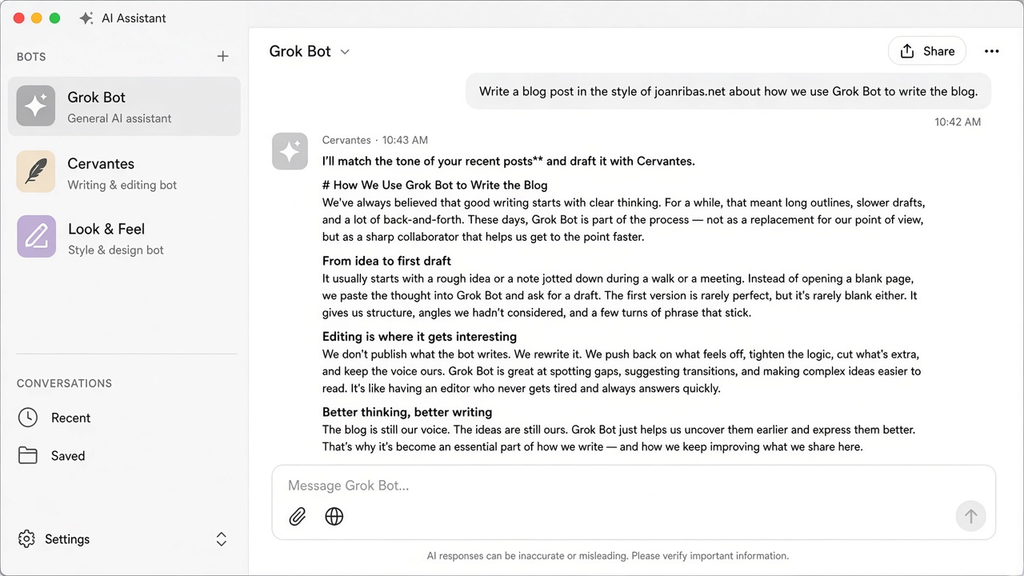
That screenshot isn’t just for decoration. It’s the assignment and the moment when “casual chat” becomes a project with its own name: Cervantes.
The Real Process (Not the Demo Version)
The marketing pitch for this would be: “Just order a post and you’re done.” The reality is more down-to-earth, which is why I want to share it.
First, the assignment. The topic alone isn’t enough; you need a style agreement. In our case: a friendly-yet-professional tone (like that of The Pygmalion Effect or OpenClaw – NemoClaw ), reasonable length (~1,400–1,800 words), categories at the beginning, and a list of screenshots at the end for whoever publishes it. Without that framework, Cervantes writes “well” in the abstract but poorly for this specific blog.
Second, an analysis of what’s already been published. Before drafting, existing posts are reviewed: how we open, how we break up sections, when we switch to a command, and when we stick with a metaphor. It’s not about copying phrases; it’s about maintaining a consistent voice. The site has a rhythm (observation, context, risk, final question), and Cervantes works within it.
Third, writing on the assistant’s “computer.” Here’s a nuance that’s often lost in conversations about agents. We’re not just generating text in a dialog box: the bot writes a Markdown file, saves it to a path, counts words, suggests a slug, and describes any missing screenshots. It works like someone delivering a deliverable, not like someone chatting. That difference—product versus conversation—is what makes the experiment truly usable.
Fourth, the screenshots. Cervantes doesn’t create the screenshots; it leaves them labeled ([SCREENSHOT 1], [SCREENSHOT 2], [SCREENSHOT 3]) so that I—or whoever publishes the post—can take them from the actual desktop. The human remains the photographer and the editor.
[SCREENSHOT 2]
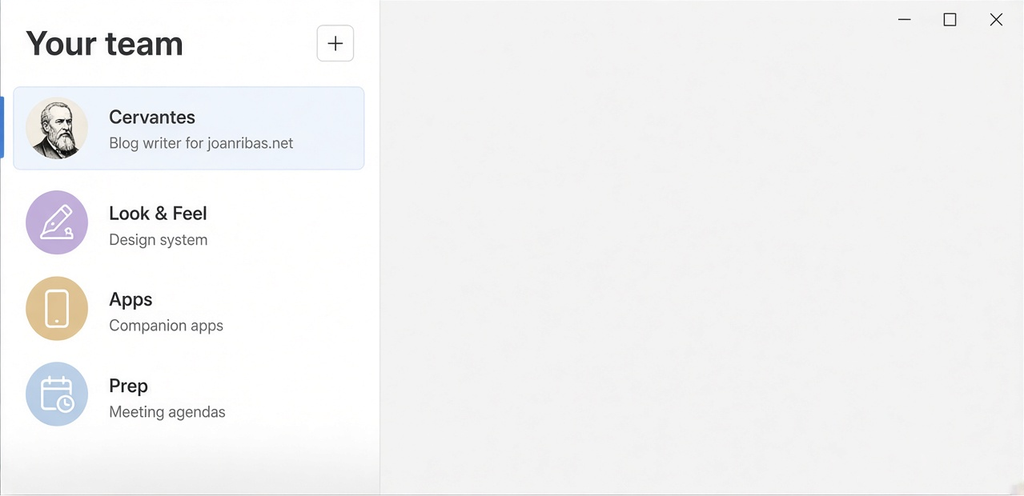
Here you can see the leap: it’s no longer an improvised monologue; it’s a role on the team (“Blog writer for joanribas.net”) alongside other roles. If this sounds familiar from what we’ve already discussed with OpenClaw and NemoClaw—digital employees who read, write, execute, and remember—it’s no coincidence. Grok Bot brings that idea to the desktop where we already are: the assistant has a desk, files, and teammates.
What a Generic Chatbot Doesn’t Do (and Why It Matters)
I could have opened ChatGPT, Claude, or whatever model is trending, pasted in a long prompt, and gotten a decent draft. The difference isn’t magic; it’s working infrastructure.
Persistence. A generic chatbot forgets. A bot with memory and files doesn’t have to relearn every Tuesday that we don’t start here with “In this article, we’re going to…,” that we prefer anecdotes to abstracts, and that the conclusion is usually an uncomfortable question. That memory doesn’t replace judgment; it avoids the cost of having to re-explain the criteria.
Role. “Be a writer” is just a euphemism. “You’re Cervantes; you write for joanribas.net using these rules and this reference corpus” is a job description. In the first case, you improvise; in the second, you delegate. Quality doesn’t come solely from the model—it comes from having defined the problem.
Desktop. Working on the assistant’s computer changes the nature of the request. You can say, “Analyze these three posts, save the draft in the blog folder, count the words, and list the screenshots.” That’s collaboration with deliverables. A text box returns paragraphs; an agent in an environment returns an artifact that another bot (or you) can pick up tomorrow without copy-pasting.
Collaboration between agents. Cervantes doesn’t do layout; Look & Feel doesn’t invent the index. Cervantes doesn’t have to be the screenshots bot, the SEO bot, and the social media bot all at once. The value isn’t in a superbot that does everything; it’s in a small team with clear boundaries—exactly what we ask of human teams and often forget to ask of digital ones.
[SCREENSHOT 3]
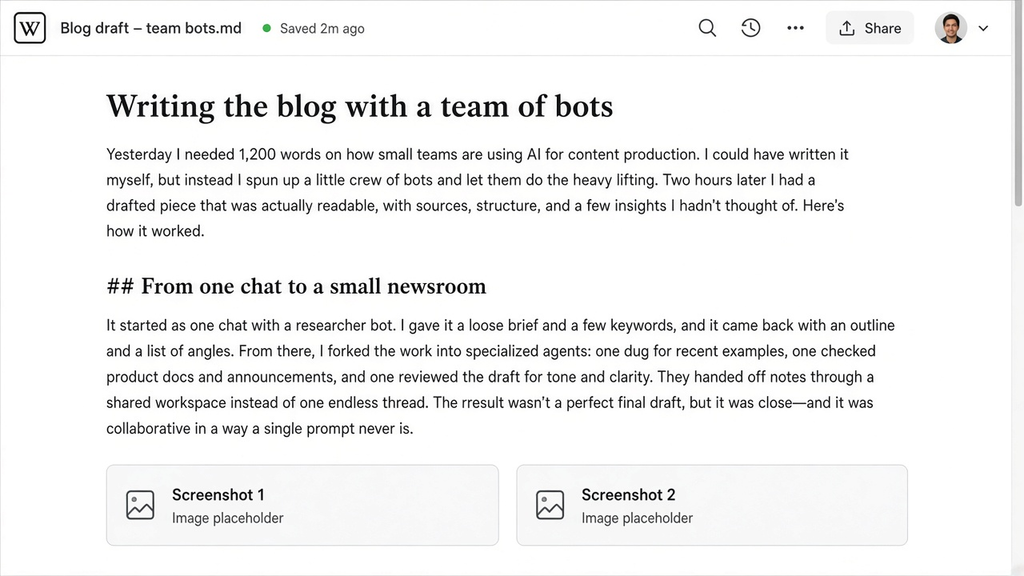
The deliverable isn’t just the talk: it’s a Markdown file with structure, sections, and placeholders for screenshots. None of this eliminates the work. It shifts it. Where I used to spend hours on the first draft, I now spend hours on the assignment, the review, and the decision to publish. Anyone who thinks “the bot writes and I just hit publish” hasn’t read Living with AI / all the way through.
Human Review, Bias, and Conscious Irony
There’s a dangerous temptation: since the text “sounds good,” to assume it’s already done. It’s the same old trap with sleek automation. In OpenClaw – NemoClaw , we insisted that power without a helmet is like an intern with the keys to the factory. Something similar happens with blogging, although the damage isn’t wiping out a server: the damage is publishing a voice that isn’t your own, or an idea you didn’t think of, wrapped in your byline.
That’s why the workflow always ends with human review. I read to look for what the model tends to do: excessive symmetry, overly neat lists, cheap conclusiveness, that polished phrase that says nothing. I also look at the bias in the corpus: if Cervantes mimics recent posts too closely, the blog becomes an echo of itself. If it mimics the generic “AI tone” too much, it ceases to be this blog.
There’s another, more subtle risk that we already pointed out in Living with AI : the more generated text feeds into what we read and what we regenerate, the easier it is for the loop to close without anyone noticing. That’s why Cervantes reads real human posts—including mine, with all their flaws—and I keep throwing in anecdotes that weren’t part of anyone’s training.
And here comes the meta-irony I don’t want to hide: this post is a perfect example of what I’m describing. I asked for it in the blog’s style. I put Cervantes to work. Existing posts were analyzed. A complete Markdown file was drafted, complete with capture markers and metadata for publishing. I review it, tweak it, trim the excess, and decide whether or not to publish it. If you’re reading this on joanribas.net, the human review won out. If not, that’s fine too: sometimes the best use of an agent is to discard its output without drama.
Does that mean “AI wrote the blog”? It depends on who you ask. The model generated sentences. The role defined the style. The desktop saved the artifact. I provided the criteria, the anecdote, and the byline. Deep down, it’s the same question that closed Living with AI, only now I’m the experiment: who really wrote this?
The useful answer isn’t a percentage. It’s a process. A digital team with roles, deliverables on a computer, snapshots of the real world, and a person who refuses to publish blindly. The rest is noise or marketing.
The question isn’t whether bots will write blogs; that’s already happening. It’s another one: when the team behind a post includes agents with their own names, what part of the craft are we willing to delegate… and what part, if we let it go, ceases to be our craft?