We’ve all come across scorecards at some point that include all kinds of metrics, which we could classify into the four classic perspectives: financial, customer, internal processes, and learning and growth. On paper, having this is already an advantage and an impeccable application of the Balanced Scorecard. The problem arises when we ask ourselves which indicator we would consider most important if we had to choose just one to focus on. This is a difficult question to answer when the scorecard measures everything with equal weight; there is no clarity regarding what the company actually wants to excel at. We have the instrument, but we lack the score.
As Richard Rumelt says in his book Good Strategy/Bad Strategy
“strategy” should mean a cohesive response to an important challenge.
And that cohesive response also addresses which initiatives and metrics we need to prioritize whenever we have to make a decision.
That “where the company wants to win” is exactly what the Value Discipline Model addresses, and that’s why I believe it’s worth discussing to complement balanced scorecards and strategy maps.
What Is the Value Discipline Model
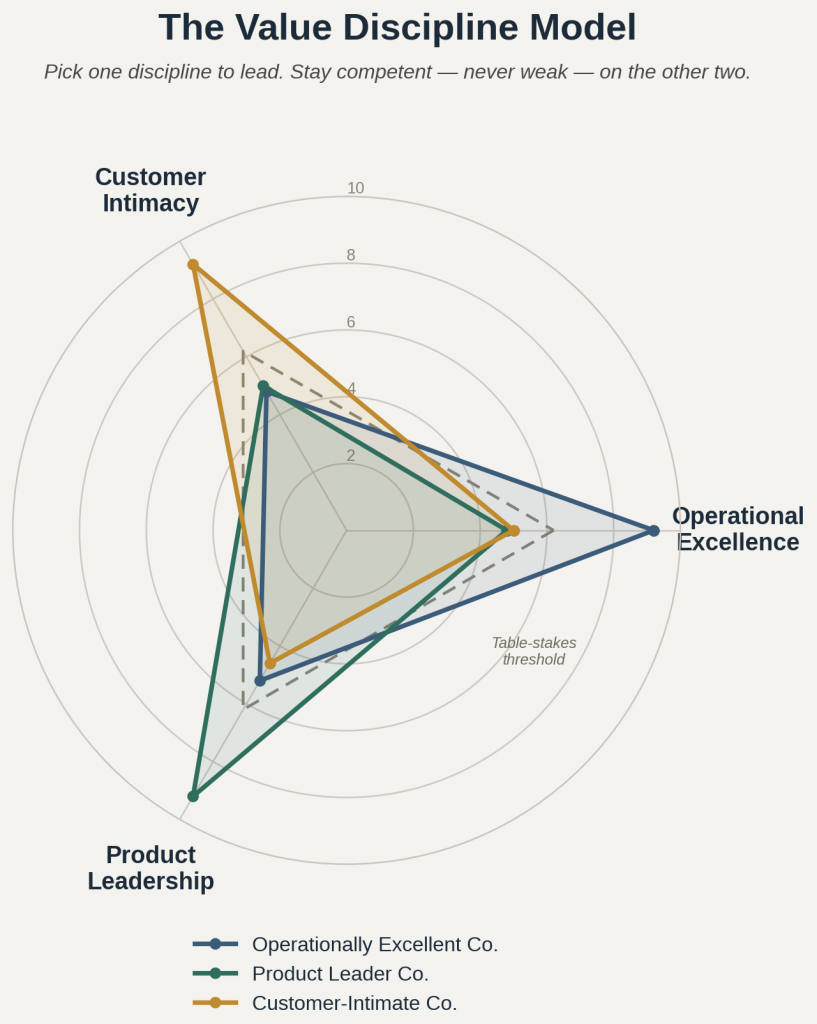
The model, proposed by Michael Treacy and Fred Wiersema in the mid-1990s, is based on a simple idea: no company can be the best at everything at once, so it makes sense to consciously choose which dimension of value it wants to excel in relative to its competitors, while accepting that it will be merely competent (not necessarily a leader) in the others. The authors propose three value disciplines:
- Operational excellence. Competing by offering the best total price and the highest reliability, thanks to optimized, efficient, and frictionless processes. This is the discipline of those who win by doing things more simply and more cheaply than anyone else. Companies like Walmart and Amazon prioritize process optimization and cost reduction.
- Product leadership. Competing by offering the best possible product, with constant innovation and a willingness to cannibalize one’s own success to avoid falling behind. This is the discipline of those who win by always staying one step ahead. Apple and Tesla are good examples of this, as they make significant investments in R&D to stay ahead of the competition.
- Customer intimacy. Competing by offering the best comprehensive solution for specific needs, building deep relationships, and tailoring the offering to each customer or segment. This is the discipline of those who win by knowing the customer better than anyone else. Nordstrom and the Ritz-Carlton are known for their exceptional customer service and personalized attention.
The central idea is not that the other two dimensions don’t matter (a company cannot afford to have chaotic processes, a mediocre product, or terrible service), but rather that only one of them can truly make the difference; and it is toward this one that the most difficult decisions regarding resources, investment, and priorities are directed. Trying to be a leader in all three simultaneously usually ends up, in practice, with the company failing to truly stand out in any of them.
Why This Choice Is So Important
Choosing a value discipline is not a marketing exercise; it is a decision that determines virtually everything else: which processes are optimized first, what types of employees are hired, what is measured, what is rewarded, and even what kind of systems architecture makes sense to build. A company competing on operational excellence will need highly standardized processes and robust, predictable systems; a company competing on customer intimacy, on the other hand, will need flexible systems capable of customizing its offerings on a case-by-case basis. These are distinct enterprise architecture decisions, derived from a prior strategic choice, very much in line with what we discussed when talking about thinking of the organization as a whole rather than optimizing each part separately.
The Connection to the Balanced Scorecard
This is where the Value Discipline Model connects with a much better-known tool: Kaplan and Norton’s Balanced Scorecard. The Balanced Scorecard proposes measuring organizational performance from the four perspectives we discussed earlier (financial, customer, internal processes, and learning and growth) rather than limiting itself to purely financial indicators, which are always lagging and fail to explain the reasons behind the results.
The common mistake, as in the example at the beginning of this post, is to treat the four perspectives as if they all carried the same relative weight for any given company. And that is where the Value Discipline Model provides the criterion that the Balanced Scorecard lacks: the chosen value discipline indicates which perspective, and which objectives within it, should carry the most weight in the design of the scorecard. The end result is an improvement in the financial perspective, but it is the combination of the other three perspectives that will get us there. A company focused on operational excellence should place special emphasis on internal process indicators (cost, cycle time, quality, productivity); a company focused on product leadership should strengthen the learning and growth indicators linked to innovation and R&D capacity; and a company focused on customer intimacy should prioritize the customer perspective indicators related to loyalty, personalization, and customer lifetime value.
Without that initial choice, the Balanced Scorecard runs the risk of becoming what we saw at the beginning: an exhaustive exercise in measuring everything without really knowing what to measure or why, which is precisely the problem this tool was intended to solve.
Strategy Maps: The Missing Link
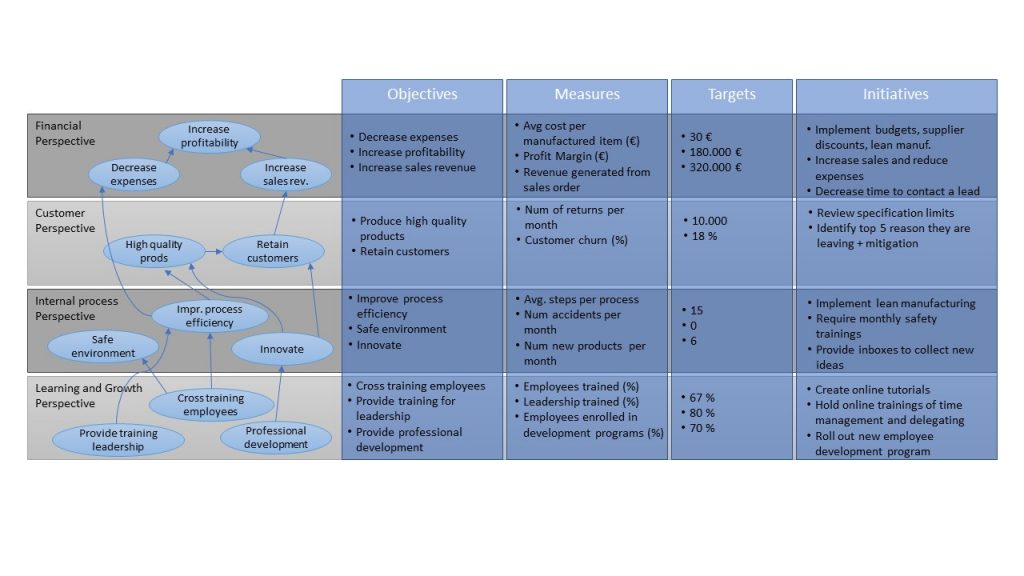
The Balanced Scorecard, on its own, is a list of metrics organized into four perspectives. What gives it narrative meaning, and what truly connects the value disciplines to day-to-day operations, are strategy maps, the tool that Kaplan and Norton themselves later developed to represent the cause-and-effect relationships between the objectives of the different perspectives.
A strategy map is read from the bottom up: the learning and growth objectives (people’s capabilities, systems, culture) enable the internal process objectives; these, in turn, generate the value proposition that impacts customer objectives; and these, finally, translate into the financial results sought by shareholders. It is, in essence, the same logic of aligning local objectives with global objectives that we discussed some time ago, but represented as an explicit causal chain rather than a simple list of independent goals.
The chosen value discipline is what determines which causal chain makes sense to prioritize. If the company competes on the basis of operational excellence, the relevant chain likely places emphasis on process standardization and culminates in cost leadership; if it competes on the basis of product leadership, the chain likely places emphasis on innovation capacity and culminates in the customer’s willingness to pay a premium price. The strategy map makes more sense when there is an underlying value discipline.
Lead KPIs and Lag KPIs: Measuring the Cause and Measuring the Effect
This cause-and-effect chain naturally leads us to distinguish between two types of indicators.
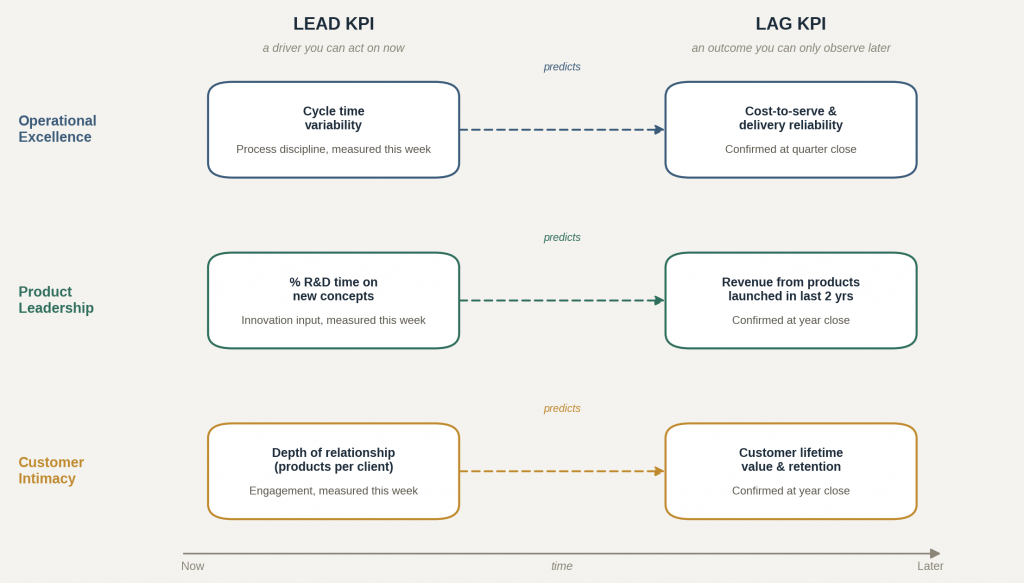
- Lag KPIs (outcome indicators) measure what has already happened: revenue, market share, and customer satisfaction at the end of the quarter. They are easy to understand and impossible to change retroactively: by the time you see them, it’s already too late to act on them.
- Lead KPIs (predictive or trend indicators) measure what is happening now and what, with reasonable confidence, will determine future results: a process’s cycle time, number of defects per batch, training hours per employee, adoption rate of a new feature.
A well-designed scorecard combines both types but prioritizes the lead KPIs that are truly linked (according to the strategy map) to the lag KPIs the company wants to improve. And here, once again, the value discipline helps determine which ones matter most: for a company focused on operational excellence, a relevant lead KPI might be the percentage of automated processes or variability in delivery time; for a company focused on product leadership, it might be the percentage of revenue from products launched in the last two years; for a company focused on customer intimacy, it might be the depth of the relationship, measured by the number of products or services subscribed to per customer.
Without this distinction, it’s common to end up with scorecards filled with lag KPIs and virtually devoid of indicators that allow for anticipation and timely action.
The Underlying Value for Business Strategy
Taken together, these three tools form a coherent chain: the Value Discipline Model answers the question of where the company wants to compete; the strategy map translates that choice into an explicit chain of causes and effects among the different dimensions of the business; and the Balanced Scorecard, supported by well-chosen lead and lag KPIs, makes it possible to verify whether the organization is truly moving in that direction or merely appears to be.
Without the first piece, the other two lose their ability to prioritize and run the risk of treating everything as equally important; which is the same as treating nothing as truly important. As we mentioned when discussing the importance of setting clear objectives, people lose their way when they don’t know where they’re going; and an entire organization loses its way in the same way when its scorecard does not reflect a real choice about where it has decided to win.
Ultimately, the question we asked ourselves; what is the most important indicator on the balanced scorecard if we could choose only one; is not an awkward question by chance. It is, quite simply, the question that must be answered before we begin measuring.