If we had two team leaders who, almost at the same time, were assigned an employee with a history of mediocre performance; if one of them treated that person from day one as someone with untapped potential, giving them projects slightly above their level, giving them the benefit of the doubt when they made their first mistakes, and taking the time to explain the reasoning behind decisions; and the other treats them, without saying so openly, as someone who probably won’t amount to much more: assigning them routine tasks, scrutinizing their work more closely than that of others, and giving them little leeway for any mistakes. A year later, the difference in performance between the two situations will be striking, and not because the two people are different. We’re talking about the same person at comparable points in time; but because each manager’s expectations will have shaped, almost imperceptibly, the behavior of everyone involved with that person.
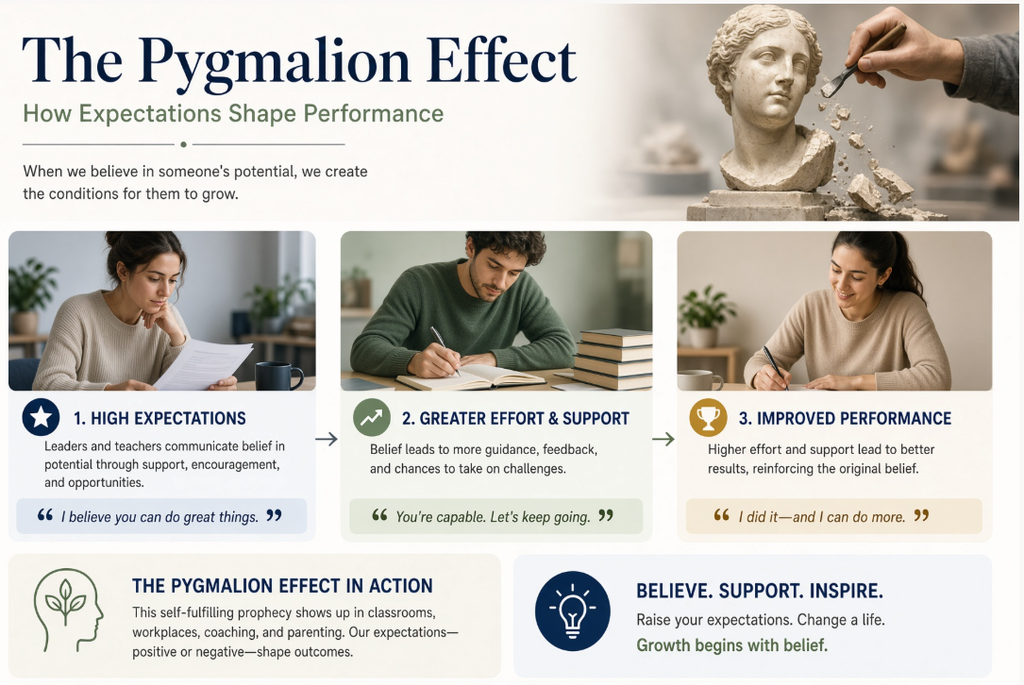
This phenomenon has a name: the Pygmalion effect, and understanding it is especially important for anyone who manages people (and for ourselves), because it operates even when we believe, in all sincerity, that we’re being objective.
Where does the name come from?
The term comes from the Greek myth of Pygmalion, the sculptor who carved a statue so perfect that he fell in love with it, and whose desire, according to legend, turned it into a living being. Psychology borrowed the name in 1968, when Robert Rosenthal and Lenore Jacobson published a now-classic experiment: they told a group of teachers that certain students (who had actually been chosen at random) showed special intellectual potential based on recently administered tests. Months later, those students (who had shown no real initial difference from their peers) had measurably improved their performance. The only thing that had changed was the expectations their teachers had of them.
What’s interesting is not that the teachers lied or that they deliberately treated those students better. The change was much more subtle: a warmer behavior, more patience when students had questions, more opportunities to respond in class, and more detailed feedback. No one consciously decided to do any of this; it happened because the expectation altered their behavior, and their behavior altered the outcome, which in turn confirmed the original expectation. A self-reinforcing cycle, in any direction.
How It Manifests in Organizations
Translated to the business world, the mechanism is identical. J. Sterling Livingston documented this as early as 1969 in a Harvard Business Review article on sales management: Managers who expected more from their salespeople consistently obtained better results from them, not by chance, but because that “expecting more” translated into concrete decisions (better territories, more training, more time spent mentoring, and greater trust during difficult times) which the salespeople themselves ended up justifying through their performance.
This mechanism typically operates through a few very specific, almost always unconscious levers:
- Quality and frequency of feedback. We give richer, more improvement-oriented feedback to those we consider promising; to those we consider limited, we give sparser or purely corrective feedback.
- Access to opportunities. High-profile projects, important clients, and decisions that allow for learning tend to be reserved for those already labeled as high-potential, while the rest are given routine tasks that make it difficult to demonstrate anything beyond the ordinary.
- Tolerance for error. The same mistake is interpreted differently depending on prior expectations: in one case, as an explainable exception; in the other, as confirmation of what was already suspected.
- Body language and tone. Warmth, patience, the pause before interrupting someone who is hesitating: these are micro-signals that the other person perceives much more clearly than we usually imagine, and which influence their confidence in taking action.
And there is also the opposite side of the phenomenon, known as the Golem effect: when low expectations lead, in an equally self-fulfilling way, to poorer performance than the person would be capable of under other conditions. In practice, both effects coexist in any organization that categorizes people, even informally, into “those who show promise” and “everyone else.”

Why It’s So Dangerous in Business Leadership
The risk isn’t just individual, it’s structural. The “high-potential” labels assigned during a person’s first few months in an organization, often based on first impressions, their alma mater, or their resemblance to the person evaluating them, tend to perpetuate themselves for years, because they generate exactly the kind of treatment that produces the performance that seems to confirm them. Those left off that list rarely get a real second chance to prove themselves wrong, because they never receive the treatment that would allow them to do so.
This ties into something we discussed when talking about the Hawthorne effect: people don’t perform in a vacuum; they perform within the context of the attention, treatment, and expectations they receive from their leaders. Ignoring this reality and continuing to believe that we evaluate performance purely objectively is, in and of itself, one of the most costly biases an organization can have, because it silently distorts decisions regarding promotions, training, and project assignments for years, without anyone noticing or questioning it.
How to Counteract It
The Pygmalion effect cannot be eliminated. At its core, it is a natural consequence of how relationships between people work. What can be done, however, is to manage it consciously rather than letting it run its course:
- Make expectations explicit, even to oneself. Before conducting an evaluation or assigning a project, honestly asking yourself what is expected of each person and why is the first step toward detecting bias before it leads to unequal treatment.
- Ensure equal access to opportunities. Instead of reserving high-profile projects for those who already stand out, deliberately rotating these opportunities helps ensure that actual performance (and not just prior labels) determines who demonstrates what they’re capable of.
- Use structured evaluation criteria. Rating scales open to personal interpretation are fertile ground for the Pygmalion effect; specific criteria that are comparable across individuals reduce the likelihood that first impressions will skew everything that follows.
- Diversify who evaluates and who mentors. When a single person maintains an evaluative relationship with another for years, it multiplies the risk that an initial expectation; whether accurate or not; will be perpetuated without ever being challenged by a different perspective.
- Be mindful of your own language and body language. Paying conscious attention to how much time you give each person to respond, how much warmth you convey, and how much leeway you allow for mistakes is an uncomfortable but highly revealing exercise regarding your own unspoken expectations.
- Express confidence out loud. Paradoxically, one of the most effective ways to harness the Pygmalion effect positively is to explicitly tell someone that you have confidence in their abilities, rather than letting that confidence, or its absence, be conveyed solely through behavior.
The Unintentional Sculptor
In the end, those who lead people resemble the Pygmalion of the myth more than they are usually willing to admit: we do not sculpt with our hands; we sculpt with our expectations, with the time we devote, with the leeway we grant, and with the trust we convey or withhold. The difference from the myth is that in organizations there is not a single statue or a single sculptor: every person we lead is being sculpted, day by day, by the expectations of those around them, often without either side being aware of it. It’s worth asking ourselves, from time to time, what we’re really sculpting.